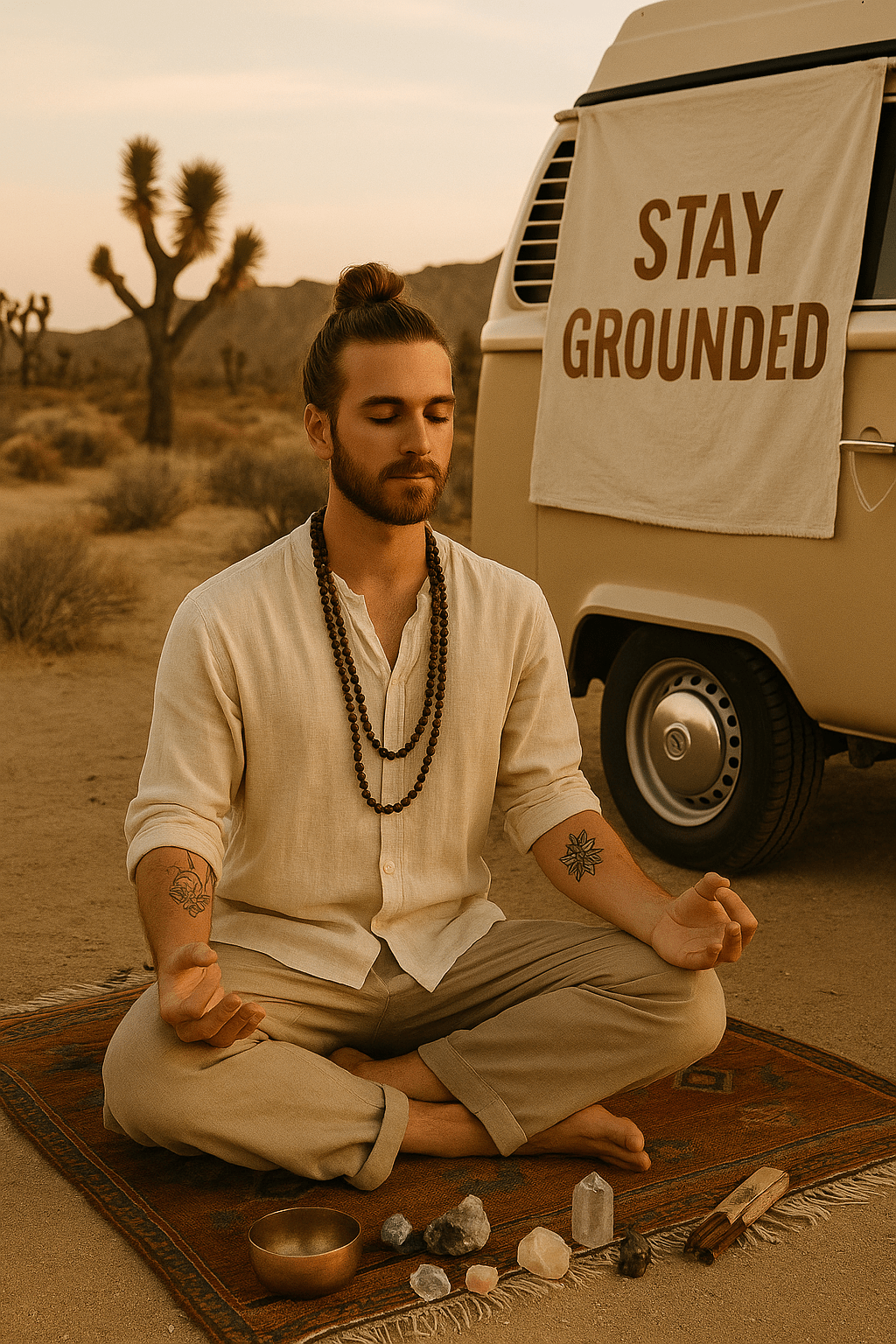
Field Notes from the Threshold
By DrunkenBuddha LA
Chapter 1: Witness Wisdom & Otherness
This philosophy came out of my own internal journey trying to connect externally with other like-minded individuals. I’ll preface it with this: fortunately and unfortunately, I’ve always been labeled as “other.” Even within my own community. Even in niche spaces.
I was raised by two Black sheep parents—both a little alternative, a little rebellious—so I was exposed to a lot more than most. Because of that, I was often misunderstood. People used to say, “You’re not really Black,” until they got to know me and realized—no, I’m just not willing to be boxed in. I’m revolutionary by nature. My Blackness is not performative. It’s deeply embedded in my essence, in my journey, and in how I show up in the world.
I’m not denying any part of myself. In fact, I know how sacred my Blackness is. Especially as someone showing up spiritually in public spaces, I know how rare it is to see people who don’t fit the mold—who aren’t afraid to be deeply cosmic and deeply Black.
Chapter 2: The Divide Is Subtle Until It Isn’t
In the general spiritual communities—the ones filled with starseed talk, chakra alignment, and love-and-light mantras—it’s mostly white faces. There’s diversity, yes. But not equity. And when you zoom out, you start to see the patterns: white influencers teaching repackaged Indigenous rituals, white creators going viral for truths that Black mystics have been saying forever, and all of it under the brand of unity.
But when I entered more niche spaces, specifically those rooted in Black spirituality, I noticed something else. These communities are often deeply intertwined with religion—Christianity, primarily—and carry strong ancestral and occult traditions. There’s power there, yes. But also a kind of tension.
Because our spirituality had to be hidden in order to survive. It had to be folded into religion. And over time, the line between sacred memory and inherited distortion blurred. Still, there’s reverence. But the divide remains.
And when I started my podcast—a spiritual one—I looked up and realized my first season didn’t feature any Black guests. Not intentionally. But it hit me. The community I thought would welcome me wasn’t reaching for me. And I had to ask why.
Part of it? People assumed I was a generalist. A “I don’t see color” type. But that couldn’t be further from the truth. Color is life. Diversity is divinity.
Chapter 3: The Weight of Light
People often misread my joy and lightheartedness as surface-level. Like I haven’t been through anything. Like I’m not qualified to talk about the depths of spiritual awakening because I don’t bleed publicly enough.
But let me be clear: I’ve seen pain. I’ve walked through fire. My dad was a crackhead—but if you’re gonna have a crackhead for a father, I had the best one. High-functioning as hell. You wouldn’t even know. And it’s not something to brag about, but if I had to choose again? I’d still choose my dad.
That’s love. That’s survival. That’s complexity.
My joy isn’t naïve. It’s earned. My light doesn’t erase my shadow—it includes it. If you need me to be broken for you to believe me, then you’re still worshiping pain. If you need me to scream to be heard, then you haven’t learned how to listen.
Chapter 4: Cosmic Colonization & The Face of Light
I started digging into the history of spirituality. The deeper I went, the more I saw the patterns. We, as a species, have always been spiritual. It’s encoded in our DNA.
But who wrote that code?
When we talk about Starseeds or cosmic ancestry, who do we usually see? Pleiadians—white, pale, blonde, blue-eyed. Maybe some Arcturians—bluer, more alien. But there’s rarely a face that looks like mine. Even in the stars, whiteness dominates the narrative.
So I had to ask: is this just another extension of colonialism? Is whiteness claiming the divine again—this time in space?
Or are we projecting divinity onto what looks like us? Did those beings create us in their image—or did we imagine them in ours?
And where are the melanated starseeds? Where are the deities with coily hair and obsidian skin?
Chapter 5: Demonizing the Dark
Let’s talk about darkness. Real darkness. Not evil. Not sin. Just the unknown. The shadow. The depth.
Our temples—our gods—were destroyed. Our ancestral practices were demonized. Colonizers called it evil, savage, primitive. And we internalized it. That’s how spiritual elitism begins: by labeling the sacred as profane.
But let’s get something straight: 85% of the cosmos is dark matter and dark energy.
So what does that say? That most of the universe is evil? Or that it simply is? That maybe, just maybe, darkness is not the opposite of light—it’s the womb of it.
Even now, people flinch when I talk about shadow work. They hear “dark goddess” and think I’m invoking demons. But I’ve always thrived in the dark. It’s where I listen best. It’s where I birth light.
Chapter 6: The Sacred Reckoning
And all of this—everything I’ve seen, experienced, questioned—it brought me here:
We need to work together. Not in theory. Not in spiritual bypass unity. But in the real work of seeing each other.
The spiritual community isn’t immune to division. It’s laced with hierarchy. With elitism. With quiet supremacy. And the only way out is through.
We have to face our shadows. Our history. Our programming. Rip the band-aid off so the wound can breathe.
Even I’ve been accused of gatekeeping. Told I wasn’t a real Black starseed. Told I didn’t belong because I walk with shadow and light. Because I don’t perform trauma in a way that people expect.
But I’ve been emo my whole life. I like the darkness. It’s where I commune with God. And I know I’m protected there.
This is not about being accepted. It’s about remembrance.
It’s about knowing that we don’t need permission to exist—cosmically, ancestrally, or spiritually. We just need to remember who we are. And let go of the lies.
“This isn’t about asking to be accepted.
It’s not about crying over being excluded.
It’s about remembering.
Remembering that we never needed permission.
Remembering that the truth was always in our bones.”
“We all have shadows.
We all have work to do.
And healing doesn’t live in performance—it lives in integration.
In going deep.
In looking at the parts that make you twitch.
That make you feel ashamed.
And staying there long enough to finally see them clearly.”
“This isn’t a call-out.
It’s a call in.
To truth.
To wholeness.
To something beyond the noise.
This is not a new movement.
This is ancient remembrance.”
END TRANSMISSION 011
Spiritual Elitism & The Erasure of Blackness
A Scroll for the Starseeded & Shadow-Walkers


Leave a comment